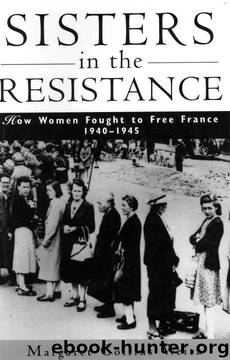
Sisters in the Resistance: How Women Fought to Free France, 1940-1945 by Margaret Collins Weitz
Author:Margaret Collins Weitz
Language: eng
Format: epub
Published: 2008-09-05T06:51:00+00:00
WHEN ONE MENTIONS RESISTANCE, ONE THINKS OF INTELLIGENCE NETworks, the maquis, and so forth-but not of support services. Resistance support services developed in response to arrests by Vichy and the Germans for acts of resistance. The work of the clandestine social assistants was not very visible. Those recruited for this work were devoted young women who did little else. They took many risks, yet their work is viewed as somewhat peripheral. Little has been written about the subject because of the marginalization of women's contributions. Yet support services also were the only area of Resistance work where positions of authority generally were held by women.
With rare exceptions, women served as clandestine social workers in occupied France. Social services sought to help prisoners and their families and to ensure the security and survival of resistants who had gone underground. Those in prison were poorly nourished and often poorly treated. They needed food packages to supplement their meager rations. Prisons were dirty and infested. The exchange of laundry was used to pass on news when correspondence was forbidden. Messages written on extremely thin paper were rolled and inserted into hems. Some enterprising women typed messages on silk, sewn to paper so that it would pass through the typewriter. The fine cloth was easily concealed. Newspapers used to wrap parcels for prisoners could convey news and information; partially completed crossword puzzles contained short messages. Brief conversations with guards and chaplains often provided important information. Clandestine social workersworking at times with their duly accredited colleagues-secured plans of prisons and helped prepare escapes.
Early on, when the Resistance was primarily an individual affair or the work of small groups, there was no pressing need for such help. Starting in 1941, however, the need arose for formal, organized Resistance support services.
Prior to the war, social services were set up for internees in French detention centers opened under the Third Republic for foreigners judged undesirable: refugees from the Spanish Civil War; political refugees from Germany; Jews and gypsies from other countries. Jewish and other organizations set up "underground railroads" to try to spirit Jewish children out of the country when Vichy and German antiJewish policies became evident. While some succeeded in living hidden in France throughout the war, it was preferable to send them to Switzerland, even though the Swiss did not always welcome them. Members of the Jewish scouting group (Eclaireurs Israelites Francais) often served as guides for the children. A number of members of their movement were killed or deported, such as Marianne Cohn. The young woman led twenty-eight children to the Spanish border without difficulty. Two-thirds eventually were able to cross, but the rest were taken into custody by the Germans. Cohn was offered a chance to escape, but she refused to leave the children. On D day, her grave was discovered. She had been so badly beaten with clubs or shovels that only her shoes enabled her brother to identify her.'
By November 1940, an umbrella organization known as the Nimes Committee was formed by
Download
This site does not store any files on its server. We only index and link to content provided by other sites. Please contact the content providers to delete copyright contents if any and email us, we'll remove relevant links or contents immediately.
| Africa | Americas |
| Arctic & Antarctica | Asia |
| Australia & Oceania | Europe |
| Middle East | Russia |
| United States | World |
| Ancient Civilizations | Military |
| Historical Study & Educational Resources |
Cecilia; Or, Memoirs of an Heiress — Volume 1 by Fanny Burney(32558)
Cecilia; Or, Memoirs of an Heiress — Volume 2 by Fanny Burney(31956)
Cecilia; Or, Memoirs of an Heiress — Volume 3 by Fanny Burney(31942)
The Secret History by Donna Tartt(19089)
Sapiens: A Brief History of Humankind by Yuval Noah Harari(14389)
Leonardo da Vinci by Walter Isaacson(13336)
The Radium Girls by Kate Moore(12028)
Sapiens by Yuval Noah Harari(5371)
How Democracies Die by Steven Levitsky & Daniel Ziblatt(5219)
The Wind in My Hair by Masih Alinejad(5095)
Homo Deus: A Brief History of Tomorrow by Yuval Noah Harari(4918)
Endurance: Shackleton's Incredible Voyage by Alfred Lansing(4783)
Man's Search for Meaning by Viktor Frankl(4606)
The Silk Roads by Peter Frankopan(4534)
Millionaire: The Philanderer, Gambler, and Duelist Who Invented Modern Finance by Janet Gleeson(4478)
The Rape of Nanking by Iris Chang(4213)
Joan of Arc by Mary Gordon(4112)
The Motorcycle Diaries by Ernesto Che Guevara(4102)
Stalin by Stephen Kotkin(3966)
